What it is
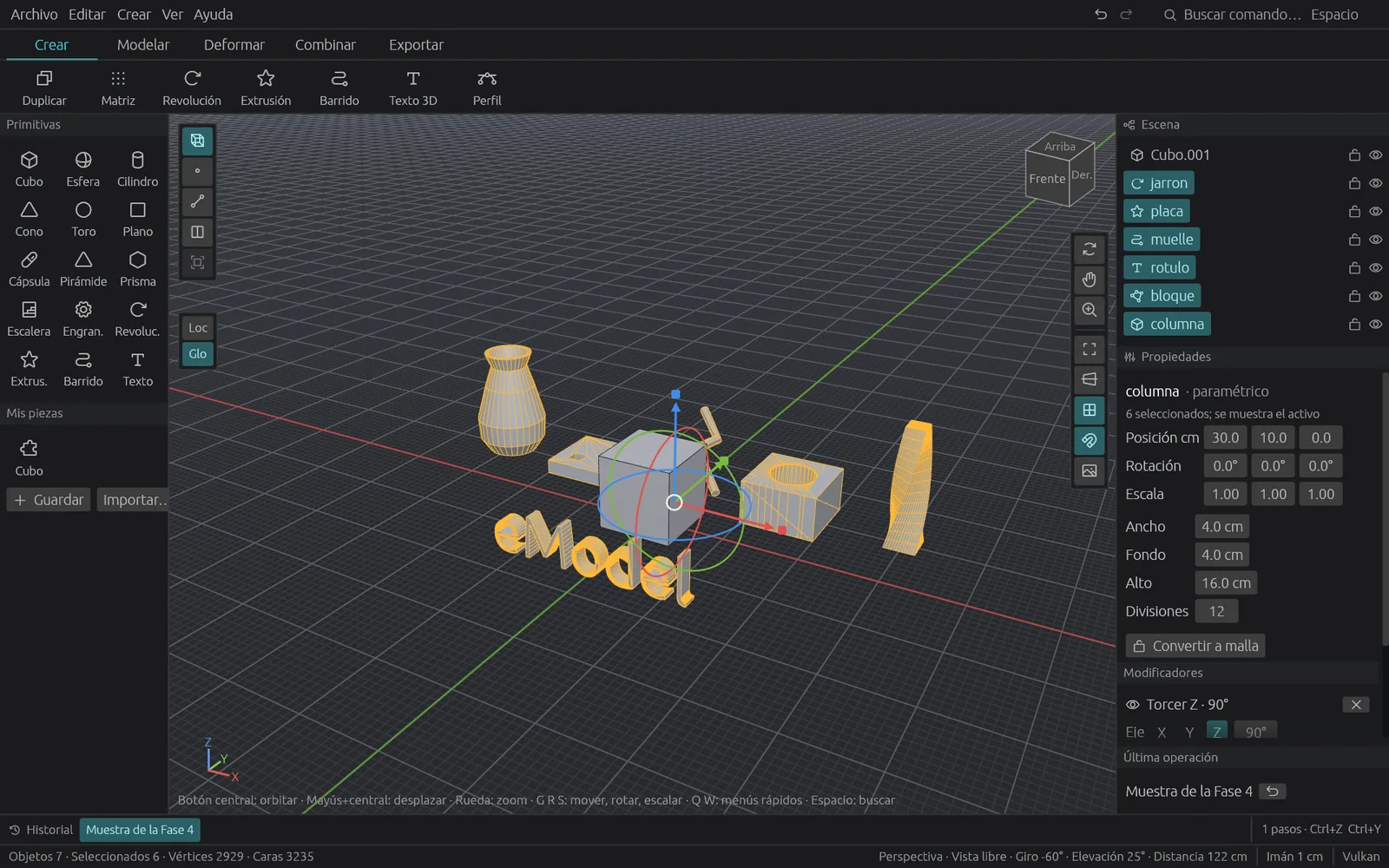
eModel3D is a 3D modeller in the spirit of trueSpace: direct, quick to learn and focused on shaping things. It is suited to parts, furniture, prototypes or models for 3D printing, with exact dimensions from the first click. It runs as a desktop program and inside the browser, and it can be driven by an AI.
How it works
Everything done to the scene —creating a part, moving a face, applying a boolean— is a command that runs the same way whether it comes from the interface, the command line, an AI assistant or an MCP server. That is why undo behaves identically in every case and a batch of changes counts as a single step.
On top of commands sit recipes: a declarative JSON format with parts, relative placement («rest on», «centre on», «next to»), repetitions and furniture templates. It is designed so a language model can describe a whole object, and the app builds it and warns when a part floats or intersects another.
Geometry lives in its own core with no graphics dependencies: a half-edge mesh, a bounding-volume tree for precise picking and BSP booleans. The viewport draws an infinite grid, faces and anti-aliased edges on the GPU, and can also render captures without a window.
Main features
- Parametric primitives (cube, sphere, cylinder, torus, stairs, gear…) created by dragging and refined with typed dimensions.
- Move, rotate and scale with axis locking and snapping to grid, angles, vertices or faces; groups, duplication and visibility.
- Mesh editing: extrude, inset, bevel, loop cut, knife, bridge, subdivide and slide.
- Live modifiers: mirror, Catmull-Clark smoothing, arrays, bend, twist, taper and noise.
- Shapes from a 2D profile: revolve, extrude with holes, sweep and 3D text.
- Union, subtract and intersect booleans.
- Four views, reference photos per view, command search and a library of your own parts.
- Exports OBJ, STL and GLB; imports OBJ, STL, glTF and GLB.
- AI assistant that models from text or photos and leaves a proposal to apply or discard.
Technology
Rust in six parts: geometry core, renderer, application, command line, MCP server and AI agent. The interface uses egui and rendering wgpu with WGSL shaders. The web version is compiled to WebAssembly and uses WebGPU, falling back to WebGL2. Models are saved in a readable text format (RON).
Limits
It is a modeller, not an animation or rendering suite: there are no materials, textures or animation (its sibling eModel3DPlus covers those). Booleans on open or self-intersecting meshes can give irregular results.
The AI assistant needs a reachable eModelServer.
In the same category
 eModel3DPlus
3D modeler and animator with hierarchies and layers, inspired by Softimage 3D.
 Pnumbra
RAW developer: basic adjustments, tone curve, auto tone and export.
 eCADMobile
Workshop notebook for tablets: a calibrated photo and a pencil sketch become a dimensioned 2D drawing, with layers, blocks and export to DXF, SVG, scaled PDF and eModel3D.