
eCie10Tutor
Learn to code with ICD-10-ES (Spanish edition of ICD-10: diagnoses and procedures).
What it is
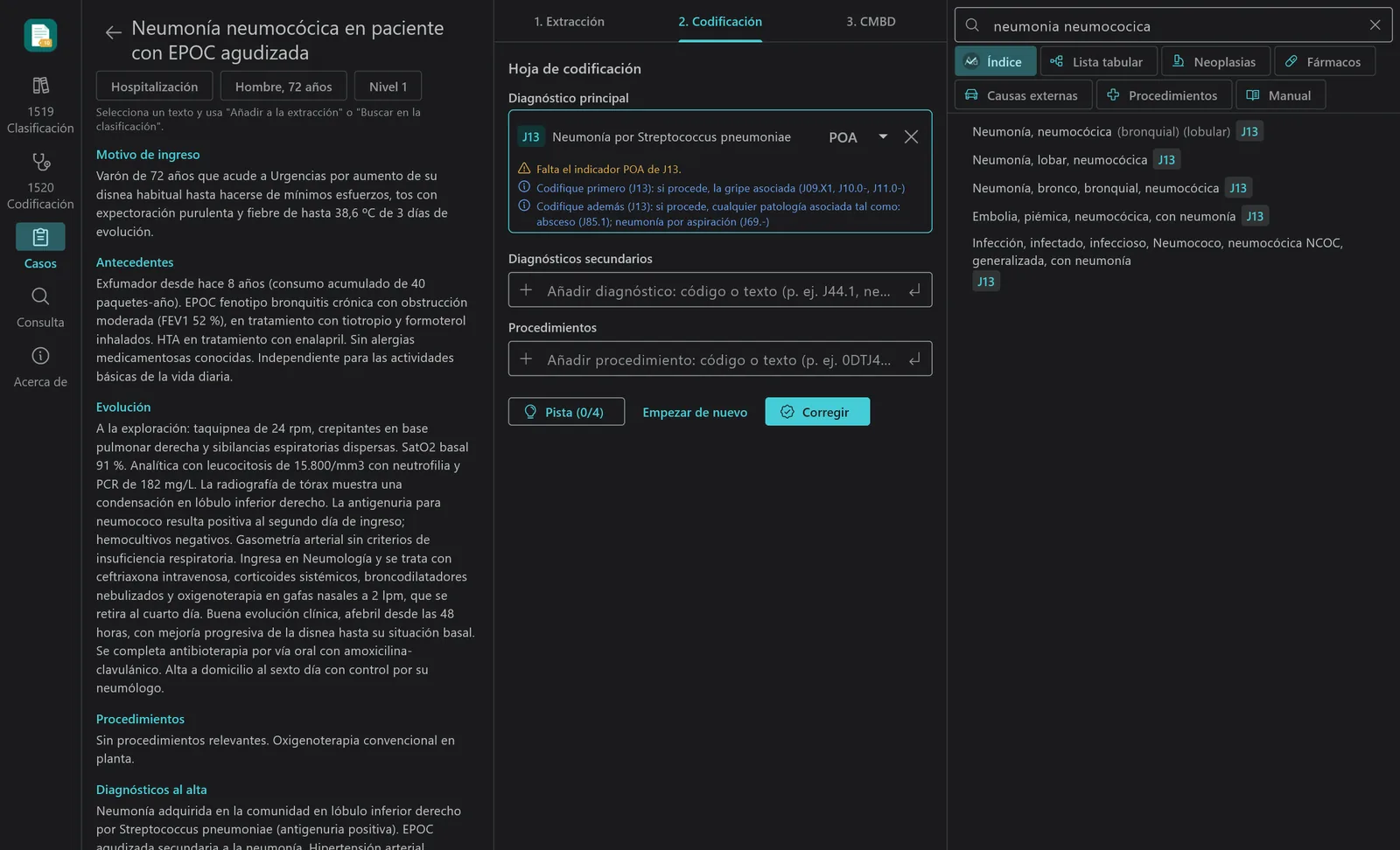
eCie10Tutor is a tutor for learning to code diagnoses and procedures with ICD-10-ES (the Spanish edition of ICD-10, 6th edition, 2026). It is meant for students of the Spanish higher vocational course in Health Documentation and Administration, and it is organised like their subjects: the modules on Health information systems and classification and on Health coding, each with its learning outcomes, its progress and the activities that work on them. It runs offline and each student keeps their progress on their own computer.
How it works
The official classification from the Spanish Ministry of Health is turned, through a data preparation process, into a read-only SQLite database that ships with the app: code catalogues with their flags, alphabetical indexes, the tabular list with its notes, the neoplasm and drug tables, the procedure tables by axis and the coding manuals split into sections.
The coding desk works on top of that database. A single screen holds the case discharge report, the coding sheet and the lookup panel. Each code is validated as it is typed against the official flags, and at the end a grader scores the answer and explains each code with the manual rule that justifies it, linked to the relevant section.
Progress, drafts and attempts are stored in a second SQLite database for the student. Cases are JSON files: the teacher can edit them or add new ones without rebuilding the app.
Main features
- 21 fictitious clinical cases reviewed with a teacher, tagged by learning outcome.
- Live validation: code exists and is final, sex and age, validity as principal diagnosis, POA flag, "Excludes 1" combinations and "Code first" or "Use additional code" reminders.
- Reasoned grading with a score, the manual rule for each code, alternative principal diagnoses and progressive hints.
- Extraction stage: underline the report, assign the role of each term and choose the main term.
- Each case's minimum basic data set (CMBD) sheet, with the register variables defined by Royal Decree 69/2015.
- Exercises generated from the classification itself: diagnosis conventions and ICD-10-PCS (root operation, approach and reading a code axis by axis).
- Theory cards with self-assessment on information systems, classifications, the history of the ICD and regulations.
- Full lookup: indexes with navigable "see" references, tabular list, tables, a procedure code builder and the manuals as text and as PDF at the exact page.
- Case editor for the teacher, using the same validator that grades the students.
Technology
Flutter and Dart with Riverpod, go_router and SQLite; the PDF manuals are shown with pdfrx. The official data is prepared with a set of Python scripts that download, parse and build the reference database. It uses the house theme, with light and dark modes.
Limits
It is study material. It does not replace the official coding regulations: the Coding Manual, the bulletins and the guidance of the Technical Unit remain the reference. The cases are fictitious and are meant for teaching only. The data comes from the Spanish Ministry of Health and is reused citing the source and date. The app is in Spanish and does not yet cover neoplasm morphology.
In the same category
 eLogica
From logic gates to your own CPU: circuit editor and simulator with tests, plus the ASH-16 CPU with assembler and debugger.
 eAnatomia
Topographic anatomy study tool: levels, regions, planes, directions and positions, with diagrams and a final test.
 eCienciasESO
Maths, Physics and Chemistry review for Spanish secondary school (2nd and 3rd ESO), with theory, exercises and labs.
 frenchi2me
French for travelling: lessons, readings, pronunciation and a voice translator.