eAnatomia
Topographic anatomy study tool: levels, regions, planes, directions and positions, with diagrams and a final test.
What it is
eAnatomia is an app for studying topographic anatomy visually. It follows the Clinical terminology syllabus of the Spanish higher vocational course in Health documentation: levels of organisation, tissues and body systems, regions and cavities, planes and axes, anatomical directions and patient positions. It ends with a test to check what has been learnt. It is designed for both computers and tablets, with large buttons that are easy to tap with a finger.
How it works
All the content is fixed data inside the app: concepts with their definitions, modules and questions. The screens only draw it, so no connection or external files are needed.
Each module opens one of three kinds of screen:
- Lesson: concept cards. In four of them, choosing a concept highlights it in a diagram.
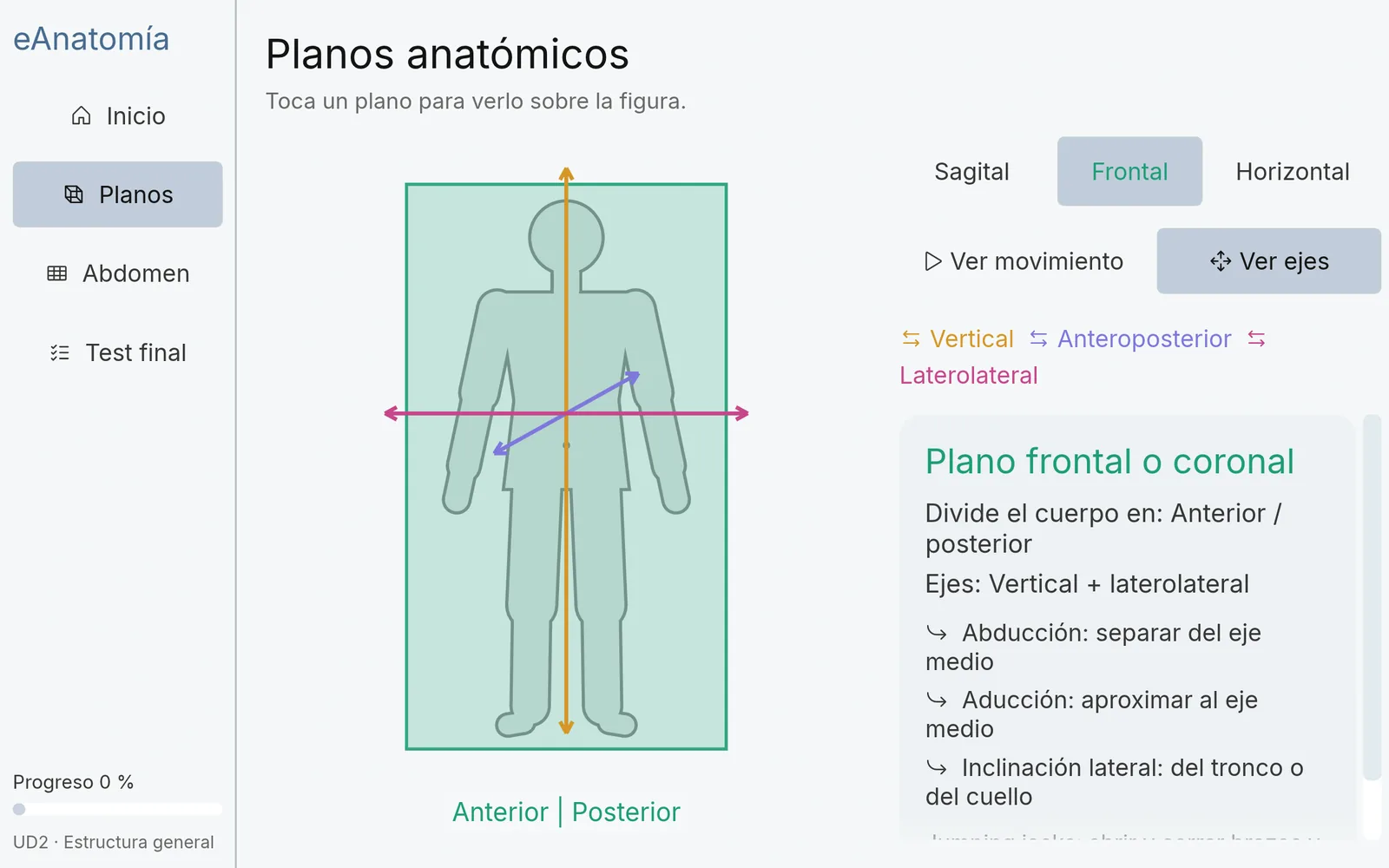
- Planes: a human figure in oblique projection with the body planes.
- Abdomen: the nine abdominal regions on the figure, ready to be tapped.
The illustrations are drawn in code, not stored as images. The interface scale adapts automatically to the size of the window or screen. Progress is saved in a small JSON file: next to the executable on desktop and in the app's internal storage on Android.
Main features
- Eight modules: six card lessons, planes and abdomen.
- Levels of organisation as a staircase, from the atomic level to the organism.
- Regions and cavities on the figure and in a side section.
- Anatomical directions with arrows on the figure and a pictogram for each patient position.
- Sagittal, frontal and horizontal planes with their axes and the movement they allow, animated.
- Abdomen in nine regions with a study mode and a challenge mode.
- Final test of 35 multiple-choice questions: 10, 20 or all of them, with shuffled options, an explanation for each answer and a review of mistakes.
- Progress kept between sessions and a system Back button that returns to Home.
Technology
Rust with egui and the house theme. The same code builds as a desktop program and as a native library for Android, without Gradle. Progress is stored as JSON with serde.
Limits
It is study material, not clinical material: it is not meant for diagnosis or to guide any healthcare decision. The figures are teaching diagrams, not detailed anatomical illustrations. The organs listed for each abdominal region are the usual ones in atlases and should be checked against each school's syllabus. The test does not ask about axes, because the source notes use two different conventions. The app is in Spanish only.
In the same category
 eCie10Tutor
Learn to code with ICD-10-ES (Spanish edition of ICD-10: diagnoses and procedures).
 eLogica
From logic gates to your own CPU: circuit editor and simulator with tests, plus the ASH-16 CPU with assembler and debugger.
 eCienciasESO
Maths, Physics and Chemistry review for Spanish secondary school (2nd and 3rd ESO), with theory, exercises and labs.
 frenchi2me
French for travelling: lessons, readings, pronunciation and a voice translator.