
eMonitor
Centralised machine monitoring: system, disks (SMART) and network of each client, with alerts, history and agent enrolment from the manager itself.
What it is
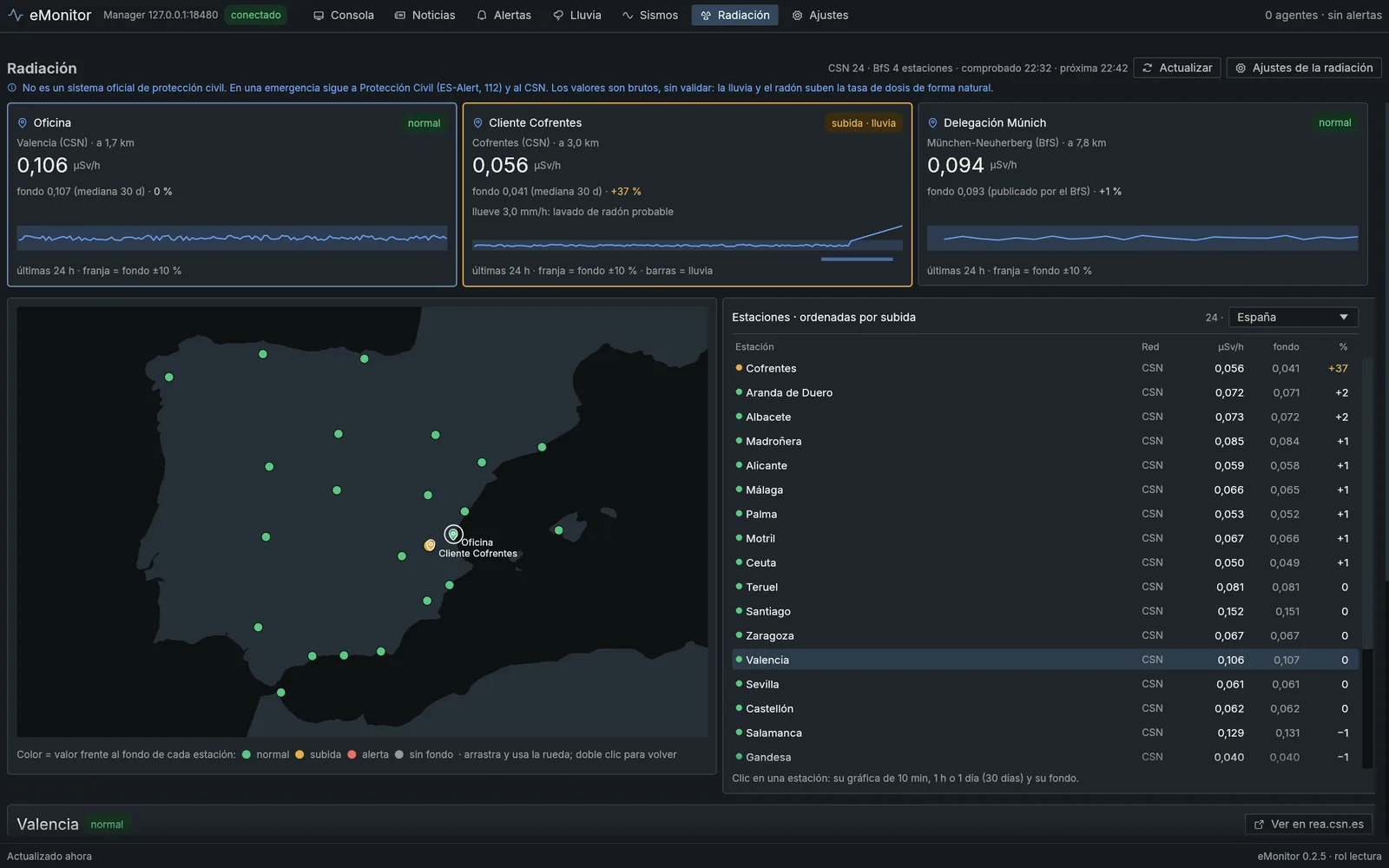
eMonitor provides centralised monitoring of the machines on a network: the system, the disks with SMART and the network of each client, with alerts and history. The interface also works as a console for alerts about the surroundings: news from feeds, the weather, expected rain, earthquakes and environmental radiation.
How it works
It consists of three programs:
- eMonitor-agente, a service on each client that measures the machine and sends the readings. If the network drops, it keeps them in an on-disk queue and resends them later.
- eMonitor-manager, the server: it receives the agents, stores the history in SQLite, evaluates alerts and builds the installation packages.
- eMonitor, the interface, which queries the manager and draws everything.
The manager creates its own certificate authority. To add a machine, the interface requests a package: the agent executable with the manager's address, its public certificate and a single-use enrolment code that expires after 7 days. On installation, the agent generates its key on the machine itself and the manager signs a client certificate for it; the private key never leaves the machine. From then on, agent and manager talk over HTTPS with mutual authentication (mTLS). The interface pins the manager's authority the first time and logs in with a token holding a read, operator or administrator role.
The history has three tiers: raw data for 24 hours, 5-minute averages for 30 days and hourly averages for 400 days.
Main features
- System (total and per-core CPU, memory, processes), disks (usage, reads and writes, health, temperature and SMART attributes) and network of each machine.
- Alert rules with threshold, duration and severity, global or per agent, plus an alert for machines that go offline.
- Graphical wizards to install the manager and the agents, or windowless installation from the command line.
- Agent updates distributed by the manager, with a time window and rollback on failure; manager updates with a prior backup.
- Revoke an agent or merge the history of a reinstalled machine.
- News: RSS, Atom and JSON Feed reader, with a feed finder and OPML import and export.
- Weather and rain: forecast from Open-Meteo, rain alerts per place, official AEMET warnings with the user's own key, and radar.
- Earthquakes (IGN, real-time EMSC and USGS) and environmental radiation (CSN, BfS and Safecast networks), with a map and desktop alerts.
- Control by an AI assistant through eHub, off by default and read-only.
Technology
Rust in eight parts: contract, core, security, collectors, installation wizards, agent, manager and interface. The interface uses egui; data is stored in SQLite; security uses rustls, ring and rcgen. Only the interface queries public services: the manager never goes out to the Internet.
Limits
Certificates expire and are not renewed automatically; if the manager's address changes, agents must be reinstalled with a new package. The installer is the executable itself with the configuration appended, not a signed package. It does not measure the GPU or capture traffic. Earthquake and radiation alerts are for guidance only: they arrive when the sources publish them and use unvalidated values. They do not replace official civil protection warnings.
Requirements
Not part of the app: installed separately from their official websites, each under its own licence.
- Your own AEMET OpenData key, only for official rain warnings
In the same category
 eOreInvest
Tracking of metals, energy, mining and crypto markets.
 eAndSMBNav
Browser for SMB2/3 shared folders.
 eNetVigía
Local network monitoring with industrial protocols: passive listening, careful scans and alerts.
 RVMManager
VMware Workstation virtual machines: scheduled start and shutdown, VMDK disks and cold backups.